
Deadlifts are one of the best exercises to strengthen your butt and lower back, but having the proper deadlifting form is not natural, but can be easy. If you don’t have the proper form you will likely injure your back. We will cover how to ensure you have proper form every time. Once you have proper setup and form you will be able to deadlift to your maximum potential.
The Deadlift is one of the three powerlifting exercises and the one that uses the most muscles. For you non-powerlifters, the deadlift will help you develop a strong back and great posture. You should incorporate the deadlift into your back routine as the primary compound movement, and test of your strength gains.
Deadlift Summary
- Primary Muscles Worked: Quadriceps, Gluteus Maximus
- Other Muscles (Secondary) Worked: Soleus, Adductor Magnus, Erector Spinae, Trapezius, Rhomboids, Levator Scapulae, Rectus Abdominis, Obliques, Hamstrings, and Gastrocnemius
- Equipment: barbell
- Mechanics Type: Compound
- Force: Pull
- Utility: Basic
Deadlift Exercise Procedure
- Stand with the feet hip with apart and your feet pointed out.
- Position the barbell directly under the middle of your foot. This should be about an inch forward of your shins.
- Reach down and grasp the bar slightly outside of your thighs with both hands grip. Some people may prefer a mixed grip, but if you are lifting to build strength and symetry you should use the overhand grip on both hands.
- Bend your knees and lower your hips until your shins touch the barbell, without moving the barbell.
- Lift your chest and straighten your back and arms until you feel the weight of the barbell in your hands.
- Breath in and tighten your core. You are now ready to lift the barbell.
- Pull the barbell directly off the floor by standing up straight, and dragging the barbell up your legs.
- Pause at the top, and breath out. Then slide the barbell back down your legs and return it to the same position on the floor.
- Repeat until you complete your desired reps.

How to Deadlift: 5 Step Starting Setup
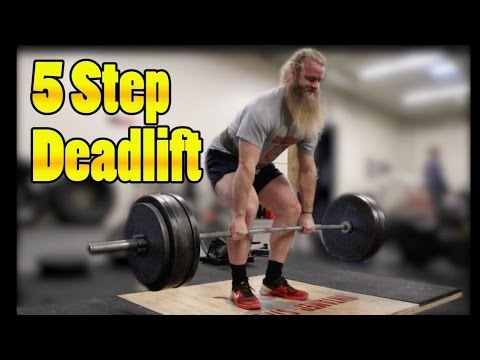
Alan Thrall provides a great simplistic procedure to set up and execute the deadlift. Additionally, Alan is very entertaining in his approach to teaching. After watching his video, you will easily remember how to set up for your deadlift in a way that will lead to lifting much heavier weights. I started using this setup method and have had much more consistent deadlifts.
5 Step Deadlift Setup
- Place the barbell over mid-foot.
- Reach down and grab the barbell.
- Bring your shins to the barbell (this will set your hips in the correct position.
- Squeeze your chest up and out and drive your knees out against your elbows.
- Drag the barbell up your body.
Muscles Utilized to Deadlift
Target (Agonist) Muscles
- Gluteus Maximus
Synergist Muscles
- Quadriceps
- Soleus
- Adductor Magnus
Stabilizers Muscles
- Erector Spinae
- Trapezius, Middle
- Rhomboids
- Trapezius, Upper
- Levator Scapulae
Antagonist Stabilizers
- Rectus Abdominis
- Obliques
Dynamic Stabilizers
- Hamstrings
- Gastrocnemius
Caution Before You Perform The Deadlift
Don’t perform the deadlift with any injuries. You will compensate for your injury by using bad form and this could lead to additional injuries. While you are doing deadlifts if you any pain, especially in your lower back you should stop. The deadlift will strength all of your muscles to develop better posture if done correctly if you perform it incorrectly there is a high probability for injury.
Tips for Performing Deadlifts
If you are looking to achieve great results and you want to look and feel like an expert when performing the deadlift, make sure you follow all these tips. You will achieve better results faster with a smaller chance of injuring yourself.
- Wear a lifting belt – A weight lifting belt will provide you additional stability for your back, help you maintain better posture and reduce your chances of injury.
- Start with a lightweight that you can easily control, to develop good form.
- Maintain your back straight. It is very important that you do not round out your lower back. You should focus on keeping your chest out and shoulders back. Lifting your chest up and shoulders back will pull your spine into proper alignment.
- Use the 5 step setup process above, every time until it is natural.
- Breath in prior to the lift, hold your breath and tighten your core while you are lifting the bar up. Then breath out during your pause at the top.
Common Errors While Performing Deadlifts

Dr. Austin Baraki, who is Alan Thrall’s coach from the previous video on deadlift setup, goes into detail on common mistakes when performing the deadlift. Austin is not as entertaining as Alan, but he is more technical as a doctor, he has a very scientific approach.
Austin’s Six Common Mistakes For Deadlift Setup and Execution
DON’T:
- Set up with your shins to close or too far away from the bar.
- Rock forward on your toes
- Sit your hips down too low.
- Let the bar swing away from your legs.
- Open the hips immediately off the floor, this will make the bar not travel in a straight line.
- Round your back. You will know that you rounded your back if you struggle at the top of the deadlift.
Errors That Will Lead You To Make The Above Mistakes
- Trying to lift to much weight, before you have developed good form.
- Not keeping the back straight. You can do this by straightening your legs without lifting the bar.
- Bouncing at the bottom of the deadlift. When you are performing a set of multiple lifts, do not try to bounce the bar of the ground. Instead set the bar down, verify you have a proper setup and lift again. If you notice that you set the bar down in a different position than your original setup, you likely rounded your back on the way down.
- Raising your hips before your shoulders, again this will round your back.
- Not tightening your core and breathing while lifting up.
Variations of the Deadlift
These variations are intended to work different subgroups of your major muscles or work your same muscles in a slightly different way. There are a lot of variations for the deadlift and this by no means is all of them. These are definitely the most common variations and ones you should be incorporating to overcome plateaus and change up your workout frequently.


Additional Exercises that Target Your Glutes and Lower Back
These exercises will work similar muscle to that of the deadlift. You can perform these lifts after your deadlift sets to further fatigue your lower back, butt and hamstrings.


Complementary and Superset Options to Pair with the Deadlift
You may do deadlifts on leg day, but most people perform lunges on back day. You can pair deadlifts with squats but that is not recommended for building muscle. Your body can only repair a finite amount of muscle tissue at a time. Subsequently, by you working all of your major muscles in your legs and back you will reduce your overall strength gains. That is why most lifters consider deadlifting a back exercise and pair deadlifts with other back lifts.


The Deadlift is one of the best compound exercises to strengthen your butt and lower back. I hope that you will have a better deadlift set up and form after reading this. There are many exercises you can pair with the deadlift, what exercises do you do on deadlift day? What do you do to warm up for deadlifting?
Save and Share This Tutorial On Your Best Pin Board With One Of These Images