Skip to content

You are here:Home arrow Fitness arrow Bodybuilding arrow Exercises arrow Reverse Barbell Curl
Reverse Barbell Curl E-mail
Written by Lynn Glenn   

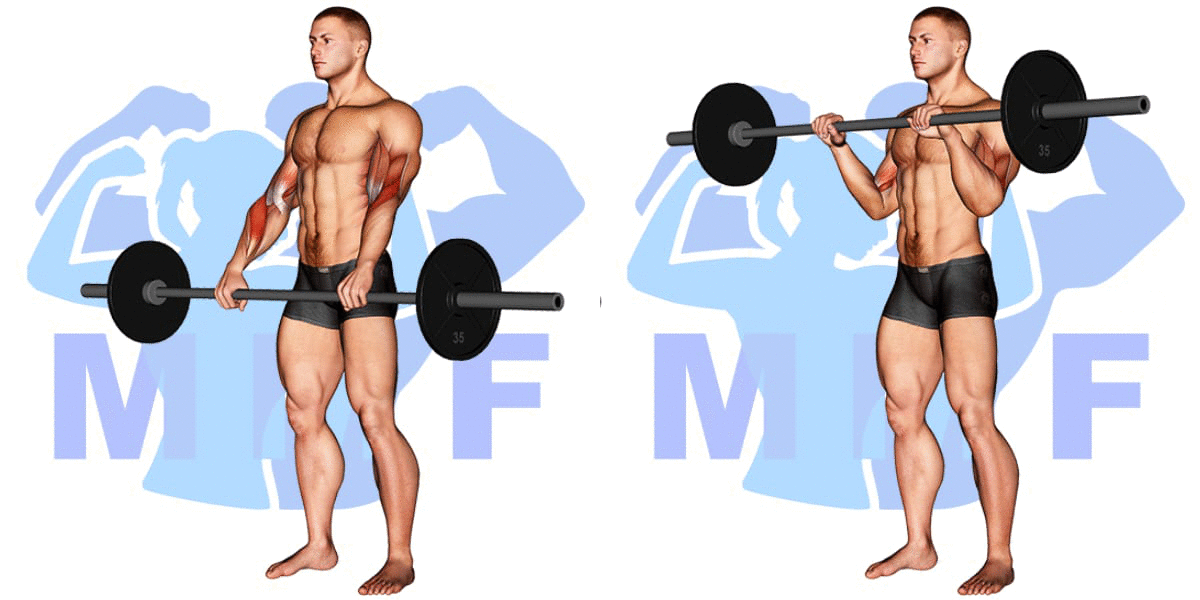
The reverse barbell curl is a exercise that develops the brachioradialis, the reverse_barbell_curlmuscle directly responsible for strengthening and developing the forearm.When done properly, the reverse curl is one most effective exercise you see being use at the gym for developing the forearm. 

Brachioradialis Muscle Physiology Summary

Brachioradialis is located at lateral supracondylar ridge of humerus and responsible for flexion of elbow; pronation and supination.

The forearm's Brachiordias muscle is easily located holding your arm at your side, your forearm parallel to the floor while making a fist and squeezing hard. Another example of locating Brachioradialis muscle would be by lifting a chair. The Brachiordialis muscle will be noticeable on top part of the forearm.

Barbell Reverse Curl Summary 

  • Main Muscle(s) Worked: Forearms Brachioradialis
  • Other Muscles (Secondary) Worked: Biceps Brachii
  • Equipment: Barbell
  • Mechanics Type: Isolation (An exercise that involves one joint movement).
  • Force: Pull (A movement toward center of body during the concentric contraction of the target muscle).      
  • Utility: Auxiliary (An optional exercise that may supplement a basic exercise. Auxiliary exercises may place greater relative intensity on a specific muscle or a head of a muscle).

Target Muscles Used for Barbell Reverse Curlreverse_curl_muscles_worked

  • Brachioradialis

Synergist Muscles Worked When Performing Barbell Reverse Curl

  • Brachialis
  • Biceps Brachii

Stabilizers Worked When Performing Barbell Reverse Curl

  • Deltoid, Anterior
  • Trapezius, Upper
  • Trapezius, Middle
  • Levator Scapulae
  • Wrist Extensors

Antagonist Stabilizers Worked When Performing Barbell Reverse Curl

  • None

Correct Exercise Procedure Use for Barbell Reverse Curl

  • Stand upright with your back and head straight, feet about shoulder width apart.
  • With both hands grasp barbell with an overhand grip (palms facing down) keeping your elbows tight against your body.
  • Starting with arms straight, barbell at your upper thighs, raise the barbell towards your chest until your forearms are vertical to the floor.
  • Lower arms slowly until fully extended.
  • Repeat.

Tips for Performing Barbell Reverse Curl 

By using the tips mention below will help for the muscle(s) fullforearm development by incorporating more muscle fibers per rep, thus increasing the muscle's size and strength.

  • Practice proper form and control. Starting with this exercise, or any exercise you have not performed before, use light weight until you have the full range of movement with proper extension and contraction completed. This is important for the muscles full development.
  • Keep elbows tight to your body. When elbow is fully flexed, the elbow should only move forward a few inches allowing the forearm to be no more than perpendicular to the floor.
  • Keep your wrist in a lock position. Keep your wrist in a locked position throughout the movement.
  • Move naturally throughout the movement. Move naturally throughout the movement by swaying your body slightly as you lift the barbell.
  • Don't move weight past tension point. It's important not to curl the weight past the point where tension leaves the forearm and bicep.
  • Use weight that allows smooth and controlled motion. This will avoid cheating which in turn will take the emphasis off the forearm.

Frequent Mistakes Made While Performing Barbell Reverse Curl 

Performing the exercise improperly, often referred to as cheating, will not allow for the muscle and muscle fibers to be use their fullest potential, resulting in not achieving desired development of the muscle.

  • Movement performed too fast. If movement is performed too fast, it will not allow full usage of all muscle fibers.
  • Using too much weight. A mistake for many lifters is trying to lift too much weight. Make sure to use correct weight, without cheating, this will allow you to use proper form and full range of motion.
  • Too much upper body movement. If you use your upper body as momentum (cheating) to help in lifting the weight you are partially defeating the lift and will not gain the muscle desired.
  • Moving weight past tension point. If you move the weight past the tension point at top of movement, this will allow your forearm to rest, thus not allowing as mush muscular gains hoped for.
  • Moving elbows to far forward.  If elbows move to far forward this will allow the shoulders and back to lift the weight with minimal emphases put on the forearms.
  • Elbows away from body. If elbows are away from your body you will incorporate other muscle groups such as biceps, shoulders and lats in helping with the lift, thus lessening the muscle gains this exercise was designed for.

Variations of Exercise or Equipment Use for Barbell Reverse Curl  

A variation of a specific exercise is intended to work different subgroups of muscles, or work the same muscles in slightly different ways. There are many exercise variations to this strength exercise. Some of the variations use for reverse curl:

  • Dumbbell Reverse Curl. Dumbbell reverse curl works the same way as the barbell reverse curl but with your forearms working independently of each other. The benefit with this exercise you can either lift the dumbbells at the same time or alternate arms. This is an excellent exercise for directly targeting the forearm (Brachioadialis).
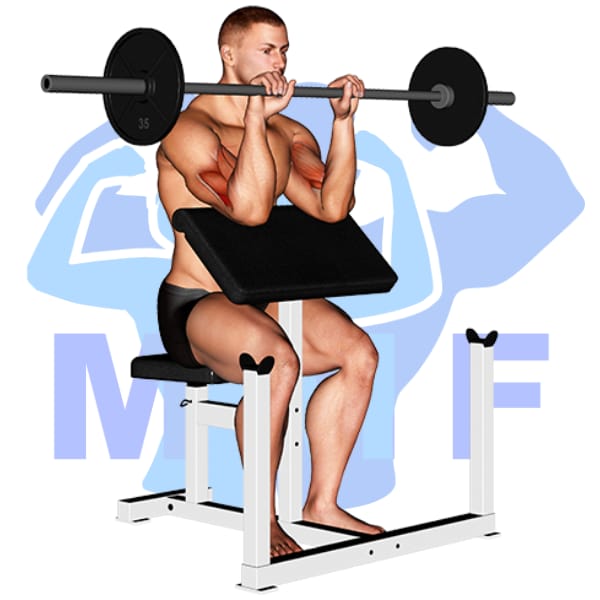
  • Barbell Reverse Preacher Curl. Your arms work together with the reverse preacher curl and performed the same as the preacher curl except palms are facing down. The benefit with this exercise, when performed correctly, arms are lock in place when resting on the pads and eliminates using the body to help with the lift.
  • Cable Reverse Curl. Again, this performed the same as the cable curl but with palms facing the floor. The benefit with using cables, it's easier to keep tension on the forearm throughout the movement.
  • Lever Reverse Preacher Curl. Hold the handles with an overhand grip and curl up like you would a barbell reverse preacher curl. One of the differences about using a machine, most have handles that swivel allowing for wrist comfort, this can be beneficial if having any wrist problems. Like with the cable reverse curl this machine allows you to keep the tension on the forearm throughout the movement.

Other Exercises to Compliment Barbell Reverse Curl 

  • Dumbbell Wrist Curl. With using an underhand grip and working each arm individually, dumbbell wrist curl is an excellent exercise for strengthening the wrist flexors (inner forearm).
  • Barbell Reverse Wrist Curl.  With an overhand grip the barbell reverse wrist curl works both forearms together in developing the wrist extenders (back of forearm).
  • Barbell Wrist Curl. Barbell wrist curl is another complimentary exercise that can be use to strengthen the wrist flexors (inner forearm) using an underhand grip working both arms together.
  • Dumbbell Seated Supination. Dumbbell Seated Supination targets and strengthens the forearm supinator. This exercise is an external rotation of the forearm resulting in the palm moving up.
  • Dumbbell Seated Pronation.  Dumbbell seated pronation targets and strengthens the forearm pronators. This exercise has an internal rotation of the forearm resulting in the palm moving down.

Bottom Line on Reverse BarBell Curls

Barbell reverse curl is a great weight lifting exercise for multiple muscle groups including back, neck and biceps. For this reason it is important to concentrate on your forearms as the main area of exertion.

Reverse curls will help strengthen your forearms so they won't fatigue while lifting weights or be painfully worn out when performing everyday tasks like cooking, yard work and holding power tools. I prefer the reverse curl exercise to be completed during or after my biceps workout. The biceps are fatigue from their exercises therefore less likely to help the forearms in lifting the weight. 

About Lynn Glenn 

Lynn Glenn
Lynn Glenn
Lynn Glenn is a 62 year old natural athlete who started training at the ripe young age of 48. Lynn Glenn is also an avid weightlifter who enjoys writing about 
hot topics in the areas of health, and fitness and developing further knowledge in the areas of disease prevention, nutritionanti aging and personal training. Lynn Glenn lives and trains in Southern California, and serves as a tremendous inspiration for many "mature" weightlifters in the gym that are trying to look better, feel better, and beat father time!  To contact Lynn, visit Lynn at http://www.musclemagfitness.ning.com/


< Prev   Next >

 Contact Our News Editors

  • For any corrections of factual information, or to contact the editors please use our feedback form.
  • Please send any medical, health, fitness or anti-aging news press releases to: This e-mail address is being protected from spam bots, you need JavaScript enabled to view it  
  Back to Front Page
 List of all Health and Medical Sections

Sponsored Links

MMF RSS Feeds

Partners

Advertisement
Advertisement
Advertisement
 

Sponsors

Advertisement
Advertisement
Advertisement
Advertisement

A to Z Health:
Allergies | Alzheimers | Anxiety | Arthritis | Asthma | Attention Deficit Hyperactivity Disorder (ADHD) | Autism | Auto-Immune Disorders | Bird Flu | Bladder Cancer | Bone Disease | Brain Tumor Breast Cancer | Cardiovascular Disease | Cervical Cancer | Cholesterol (HDL, LDL) | Chronic Fatigue Syndrome | Cold and Flu | Colitis | Colon Cancer | Colorectal Cancer | Crohn's Disease Cystic Fibrosis | Dementia | Depression | Diabetes | Eczema | Endometrial Cancer | Erectile Dysfunction | Esophageal Cancer | Eye Disease | Fibromyalgia | Gastrointestinal Problems | Hair Loss Headaches (e.g., migraines, sinus, etc.) | Head and Neck | Hearing Loss | Heartburn | Heart Disease | Hormone Disorders | Hypertension (High Blood Pressure) | Infectious Diseases | Joint Pain Kidney Cancer | Kidney Disease | Leukemia | Liver Cancer | Liver Disease | Lung Cancer | Lung Disease | Lymphoma | Melanoma | Mesothelioma | Migraines | Multiple Sclerosis | Obesity Obessive Compulsive Disorder (OCD) | Osteoporosis | Ovarian Cancer | Pancreatic Cancer | Parkinson’s Disease | Pediatric Cancer | Prostate Cancer | Prostate Health | Psoriasis | Respiratory Ailments | Sarcoma | Skin Cancer | Skin Diseases & Conditions | Sleep Disorders | Stomach Cancer | Stress | Stroke | Testicular Cancer | Thyroid Cancer | Thyroid Disease | Urology/Renal

Visitors: 1501387
Copyright © 2007 - 2010 Muscle Mag Fitness | Muscle, Fitness and Health Resource All rights reserved. Use of this site constitutes acceptance of Muscle Mag Fitness terms of service.
Designed by: HostAfric.com