

Building your lats will give you a broader chest, adding the appearance of a smaller waist. Lat pulldowns can add that v-tapper upper body you are looking for when done right.
In bodybuilding, wide lats are a critical part of the equation to developing a sexy V-taper (big round shoulders, small waist, and sweeping quads finish the package). The V-taper is built through specific training, and lat pulldowns are a good exercise to target your lats. Your lats are large muscles that must be worked, which must be developed to have a V-taper.
Lat Pulldowns Summary
- Primary Muscles Worked: Latisimus Dorsi.
- Other Muscles (Secondary) Worked: Brachialis, Brachioradialis, Teres Major, Deltoids, Rhomboids, Levator Scapulae, Trapezius, Pectoralis.
- Equipment: Cable Pulldown
- Mechanics Type: Compound
- Force: Pull
- Utility: Auxiliary
Correct lat pulldowns Procedure
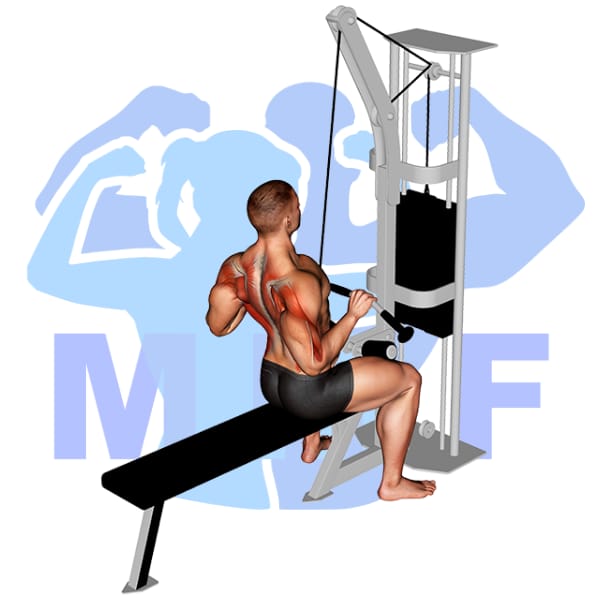
- Sit in the pulldown machine with your thigh right up under the pads (they are thigh pads, not knee pads).
- Take a somewhat wider than shoulder-width, overhand grip (palms facing in-front) on the bar.
- Start with your body vertical, arms straight over your head.
- Before you begin to pull, arch your lower back slightly and stick your chest out.
- Then pull your shoulder girdle down with your lats to start the movement.
- Continue to pull the bar down to below your chin and to your upper chest, leaning slightly backward. As you pull focus on using your lats to pull your elbows down.
- Your lats are fan-shaped muscles, and when you lean back, it spreads the load over the whole muscle.
- By pushing out your chest and meeting the bar, you will squeeze your shoulder blades together behind your back. (picture trying to hold a tennis ball between your shoulder blades).
- Finally, with control, return the bar up until your arms are straight. Your shoulder blades should rotate out in the opposite movement as when you pulled the bar down.
- Pause for a second, and repeat.

Scott Herman And His 3 Golden Rules of Pulldowns

Muscles Used For Lat Pulldowns
Target (Agonist) Muscles
- Latissimus Dorsi
Synergist Muscles
- Brachialis
- Brachioradialis
- Teres Major
- Deltoid, Posterior
- Rhomboids
- Levator Scapulae
- Trapezius, Lower
- Trapezius, Middle
- Pectoralis Major, Sternal
- Pectoralis Minor
Stabilizers Muscles
- Biceps Brachii
- Triceps, Long Head
Antagonist Stabilizers
- Deltoids
Tips for Better Results and Proper From
Lat Pulldowns should be done as a two-part movement to work your back best.
- First, Lock Your Lats into Activation. After you are in a good position, start by dropping your shoulder girdle. Next, your arms should not bend in this part of the movement, but your shoulders should drop down a few inches. You should practice this short movement a couple of times. After you have a feel for the shoulder drop, continue with the pulldown movement.
- Second, Squeeze Your Shoulder Blades Together. Once you pull the weight down so that it meets the chest, squeeze your shoulder blades together behind your back (picture trying to hold a tennis ball between your shoulder blades) for maximum force (and maximum gains).
Frequent Errors You Want to Be Sure To Avoid
The following errors are potentially dangerous, and you should avoid them to prevent injury.
- Don’t Swing Your Torso. When you are using to much weight you are likely to try to use momentum to get the weight moving. You will then reduce the effectiveness of the pulldown by taking tension off your lats. Additionally, you have the potential to injure your lower back.
- Stop Overarching Your Back. The other common error is hyperextending (over-arching) the back. This places an unnecessary strain on the lower back.
Possible Injuries when Performing Lat Pulldowns
The incorrect form may lead to multiple types of injuries, including torn ligaments/tendons in shoulders and back injuries.
Variations to Lat Pulldowns
There are many variations to the lat pulldowns, and you can easily adjust your grip, or us a different bar attachment. Each of these variations works different muscle groups or the same muscles in different ways.



Additional Lat Pulldowns that Target the Same Muscle Groups
The following lat pulldowns can be performed instead of {lat pulldowns} or to complement it.


So Now You Are An Expert On Lat Pulldowns
Where should you go from here now that you are a pro on lat pulldowns? If you want to continue to build your repertoire of back exercises check out this article.