
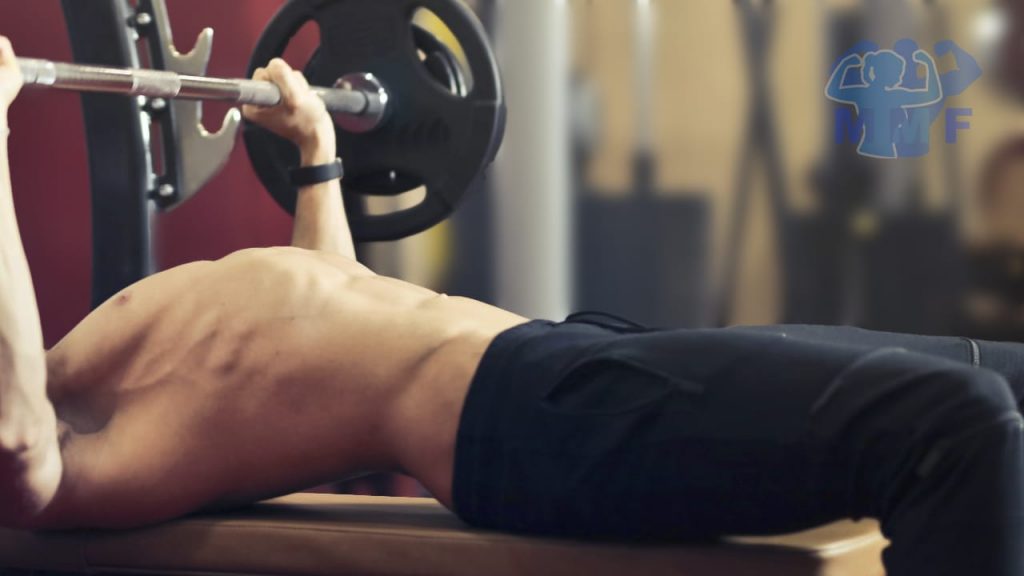
The bench press is staple strength training and powerlifting exercise where you are lying on your back and pressing a weighted barbell up. Everyone has a slightly different form when benching, base on your body type. If you are looking at how to increase bench press, read this.
Layman Introduction to the Bench Press
When you are performing the bench press lower the barbell low across your chest. Next push it back up until your arms are straight and your elbows nearly lock. The bench press concentrates on the development of your pectoralis major muscle (chest or pecs). You will also work other supporting muscles as well, including your triceps, anterior deltoids, coracobrachialis, and serratus anterior.
In the sport of powerlifting, there are only three core lifts, and the bench press is one of them. The bench press is also a primary exercise used in weight training, bodybuilding and other fitness training to develop the chest muscles.
Bench Press Variations
You can perform several variations of the bench press by adjusting your grip, grip width, bench type, and angle, etc. Some Bench Press variations are:
- Incline Bench Press. Performed on an incline bench targeting your upper chest and shoulders.
- Decline Bench Press. Performed on a decline bench targeting your lower chest. Typically, you can bench more on a decline than flat or incline bench.
- Floor Press. Bench press while lying on the floor, you can’t get a full range of motion to work your chest. If you allow the bar to come down to your chest, you will be targeting your triceps.
- Close Grip Bench Press. Shoulder width grip or narrower, this will also target your triceps.
- Reverse Grip Bench Press. Benching with your palms facing you will also target your triceps more. Take care when performing the opposite grip bench since only your fingers and not your palms will be supporting the weight.
Detailed Breakdown on How to Perform the Bench Press with Proper Form For Best Results
You want to have proper form for your body when performing the bench press to reduce the risk of injury and concentrate on utilizing your pectoralis major.
- The standard barbell bench press starting position has you lying on a bench. You should pinch your shoulder blades together to avoid utilizing the anterior deltoid during the lift.
- Place your feet flat on the floor, putting your weight on your heels. You want to keep your lower leg perpendicular to the floor. Also, your buttocks should always be in contact with the bench. Avoid pushing up you’re but and causing extreme arching of your lower back. When you keep your feet flat on the ground, you will be more stable. Additionally, to increase stability, you can separate your feet more.
- You want to grip the bar with your hands equidistant from the center of the bar. For a standard grip bench, you want your grip to be slightly wider than shoulder-width apart. When you have the bar in the down position, your elbows should be bent to near 90° with your elbows directly beneath your wrists. The bar is placed in your palms, close to your wrist on the page of your palm. Avoid gripping the bar to close to your fingers; you’ll risk wrist pain or injury.
- Keep your chest up at all time. Make sure your chest doesn’t go flat, or your shoulders don’t roll forward. Keeping your chest up will also keep your upper-back tight. When you relax your upper back, you will lose power and raise your risk of a shoulder injury.
- Shoulder-blades are kept back, down and tight at all times. With your upper back tight and shoulder-blades back your arms will have a solid base to press the bar up from.
- Your set will start by lifting the bar off of the pins, breathing in, and lowering the bar until it touches your chest.
- Then push the weight off of the chest in a straight line, while breathing out, stop when your arms are straight. Repeat by lowering the bar again and breathing in.
- After you have completed the desired number of repetitions (reps), return the bar to the pins.
Lifting Incredible Weight
In order to really push yourself, you will want to perform with a weight that will ultimately result in failure. To gain strength the fastest, you need to work to failure. Since failure in the bench press will result in you being stuck with a bar full of weights that you can’t lift on your chest, you need to have a spotter.
Performing the Bench Press Alone
You should never bench without a spotting partner unless you are just doing it to warm up and you know the weight and reps will not result in failure. I have gone to the gym alone to work out a lot, and I have asked for a random person to be to give “give me a spot.” There has never been a time when I couldn’t get a spot and is typically a friendly interaction. When you get a spotter to make sure they know what you want them to do. Specifically, let them know how many reps you think you are going to do. If you want them to help a lot or if you want them to let you struggle on the last rep.
Common Errors when Performing a Bench Press
The following Bench Press errors are either potentially dangerous and could cause injury or are inefficient and effective at improving performance. Avoid them at all costs.
- Lifting the Bar Off the Rack with Bent Arms. Your arms are strongest when your arms are straight and elbows locked. Don’t risk the bar falling on your face or chest. Unrack and bring the bar over your chest with locked arms.
- Butt off the Bench. Leave you, but on the bench, you probably can lift more weight with your butt off the bench. Lifting your butt puts you into more of a decline bench press position, and if you want to work your lower pectoralis, then perform decline bench instead. When you lift your butt during standard bench, you are putting undue pressure on your back, especially when you start pushing the weight. You’re the most stable when your butt is on the bench, keep it there.
- Bouncing the Bar off the Chest. This is one of the most common errors. Bouncing the bar reduces tension on the pectoralis (chest) muscles and can cause severe injury to your rib cage. To prevent this error, use less weight and stop the bar for a two-count at the bottom of every rep.
- Pushing Your Head into the Bench. You’ll injure your neck. Tighten your neck muscles, without pushing your head into the bench. Squeezing your back and pushing your back into the bench will provide you the best results.
- Pressing the Bar Over Your Face. The shortest distance between two points is a straight line, and you want to push the bar straight up. In order to help you push the bar straight fix your attention on a point at the ceiling where you want the bar to go. Now look at that point and push, don’t look at the bar.
- Bending Your Wrists. You could seriously injure your wrist or drop the weight, at a minimum this will result in future wrist pain. Ensure the bar is resting on your palm of your hand. Close to your wrists, not close to your fingers. The bar should be supported such that if you open your hand, the bar will not roll off your palms. You should squeeze the bar the entire time, so it doesn’t move, though.
- Elbows. Your elbows should be directly under your hands in the down position. If they are too high up your body, you could injure your shoulders. Too low and you will be using your triceps and not your chest.
- Shoulders Forward. Don’t let your shoulders roll forward. It’s bad posture, bad technique and a sure-fire way to get a shoulder injury. Keep your chest up, shoulder-blades back and your upper and lower back tight.
- Moving Your Feet. If your feet shuffle around or lift off the floor when you are bench pressing, you are breaking your base of power. You reduce the amount of power you will be able to generate and make it very difficult to keep your back and shoulders tight. In essence, you will be weaker if you move your feet.
Variation Benefits Breakdown
These variations are intended to work the same muscles in slightly different ways or different subgroups of muscles:
- Angle – the bench press can be performed on an incline bench or a decline. Additionally, you can perform a bench press on a stabilizer ball, which will help you build more support muscles. Performing the incline-version shifts some of the work from the pectorals to the anterior deltoids. Consequently, you will be working your upper pectorals more. Conversely, the decline bench allows you to lift the weight while utilizing nearly the same musculature as the traditional bench press.
- Hand Position – Varying width grips can be used to shift the work between pectorals and triceps. A wide grip will focus more on the pectorals. Whereas, a narrow grip, approximately shoulder width, will focus the effort on your triceps.
- Type of weight – Instead of a bar, the bench press can also be performed with dumbbells or a machine press. When you use dumbbells, you will be incorporating more stabilizer muscles. Additionally, dumbbells may be safer to use without a spotting partner because you can always drop them to the side with less risk of injury.
Possible Injuries
Using the incorrect form can result in multiple types of injuries to include:
- Torn ligaments and tendons in shoulders.
- Back injuries due to bridging. Bridging is slang for the arching of your lower back and turning the bench press into the decline press. To prevent bridging, you should compress your stomach muscles to force your lower back down. If you can’t help but the bridge, you can reduce the weight and bring legs up and flat onto the bench. If you bring your legs in you will be reducing your stability, that is why you should reduce the weight.
- Injuries to your trapezius muscles.
- Elbow and/or wrist strains.
- Cracked or broken ribs. This usually is the result of bouncing the bar off of your chest. Most people try to do this to add momentum to the lift or by a sudden loss of strength during the lift causing the bar to fall onto the chest.
Be An Expert
I hope you now feel like an expert in the bench press. If you are considering benching for power and you really want to learn how to increase bench press one-rep max, check out this post Everything You Want to Know About Bench Shirts. If you are bodybuilding you should check out our other exercise guides here.