
Are you looking to strengthen and lift your chest? Dumbbell Flys are a great isolation exercise for your Pectoralis Major. Use this guide to perform flys to increase strength and reduce chances of injury.
You will find that flys will develop your chest faster than pressing movements. In fact, flys allow you to work your chest without the assistance of the triceps. In other words, if you are looking to isolate your chest, there is no better way than with flys and the dumbbell fly is the most basic of all.
Dumbbell Flys Summary
- Primary Muscles Worked: Pectoralis Major
- Other Muscles (Secondary) Worked: Deltoid and Biceps
- Equipment: bench and dumbbells or floor and dumbbells
- Mechanics Type: Isolation
Force: Pull
Utility: Auxiliary
Correct Exercise Procedure For Proper Form
Using this specific form for dumbbell flys will reduce your chance of injury and maximally challenges your chest muscles. Start with a very lightweight, since the weight will be far away from your body, physics will work against you for trying to lift a lot of weight. Although, you can also have physics work for you to increase the intensity and we will discuss that later.
The Set-Up
- Grasp two dumbbells.
- Sit on a bench and place then end of each dumbbell on each knee.
- Lie back on the bench.
- Now with the assistance of your legs lift the weight over your chest. You should press it over your chest with your palms facing in.
The Execution
- Lower dumbbells to sides until chest muscles are stretched with elbows fixed. You want your elbows in a locked position but slightly bent.
- Now, bring the dumbbells back together in a hugging motion (like you are hugging a tree) until dumbbells are nearly together. Squeeze your pecs so that your shoulder blades should start moving away from each other.
- Repeat.

Target Dumbbell Flys Muscles
Target (Agonist) Muscles
- Pectoralis Major, Sternal
Synergist Muscles
- Pectoralis Major, Clavicular
- Deltoid, Anterior
- Biceps Brachii, Short Head
Stabilizers Muscles
- Biceps Brachii
- Brachialis
- Triceps Brachii
- Wrist Flexors
Antagonist Stabilizers
- Deltoid
- Rhomboid
- Teres Major
- Infraspinatus
Tips for Better Results and Proper From
To maximize your results and reduce the chances of injury, make sure you follow these tips.
- Have A Stable Base by keeping your feet flat on the ground with a wide base.
- Pinching Your Shoulder Blades Together will help you avoid recruiting your anterior deltoids during the lift.
- Keep your chest up at all times. Don’t allow your chest to go flat or shoulders to roll forward. You’ll lose upper-back tightness, losing power and increasing your risk of a shoulder injury.
- Keep Your Arms Slightly Bent. You will put unnecessary strain on your elbows if you lock your arms out straight.
- Getting Extra Reps By Working Past Failure. This is cheating in a good way, once you have nearly reached failure you can bend your elbows more and get a few more reps. By bending your elbows you change the leverage so you can continue to lift the dumbbells.
- Use The Floor Instead Of A Bench. If you are having shoulder issues you can use the floor to limit your range of motion instead of using a bench.

Frequent Mistakes You Want to Be Sure To Avoid
Performing flys improperly can lead to common injuries in your shoulder. Also, you can make the exercise more effective by avoiding these mistakes.
- Don’t Arch Your Back. By arching your back you will be trying to recruit muscle lower in your chest by changing the angle of your torso. It is better to perform decline flys if this is your goal.
- Not Locking Your Elbows. When you allow your elbows to bend you can change the
- Perform The Flys Too Fast. Not using a slow controlled motion can be jarring on your shoulder, since that is the point of rotation.
Variations To Dumbbell Flys
These variations can be used to work with different subgroups of your target muscles. In this case, you can focus on parts of your Pectoralis major. You will find that if you vary your exercises more frequently you will plateau less often or not at all.
Vary The Angel Of Your Flys
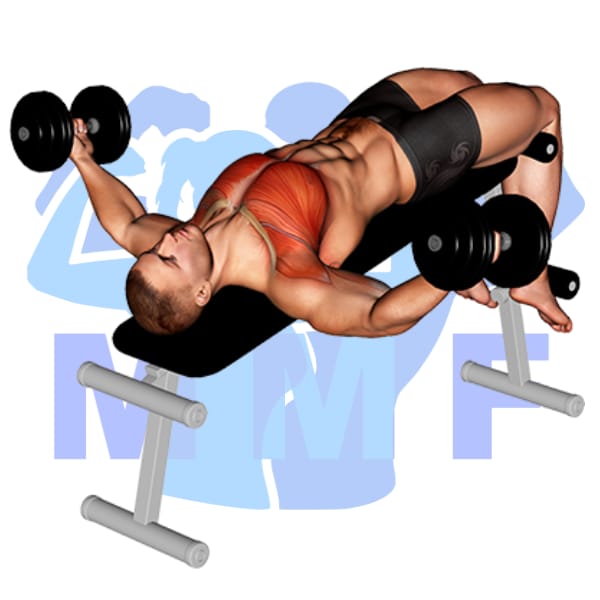
The simplest way to vary your dumbbell flys is to change the angle of your body, as such you change the area of your Pectoralis that is utilized. You can change the angle by using an incline, decline, flat bench or the floor. Additionally, you can also change the angle by using a stability ball.


Additional Exercises that Target the Same Muscle Groups
The following exercises can be performed instead of {exercise} or to complement it.


Are Dumbbell Flys For You
If you have the option to isolate your chest with the Pec Deck it is by far a superior pectoralis isolation exercise. Although you should be changing up your isolation exercises frequently to prevent your fitness level from peaking early. Adding Dumbbell flys occasionally can keep your chest growing. Don’t perform dumbbell flys if they hurt your shoulder. You can do flys from the floor or a stability ball for more support than a bench provides.