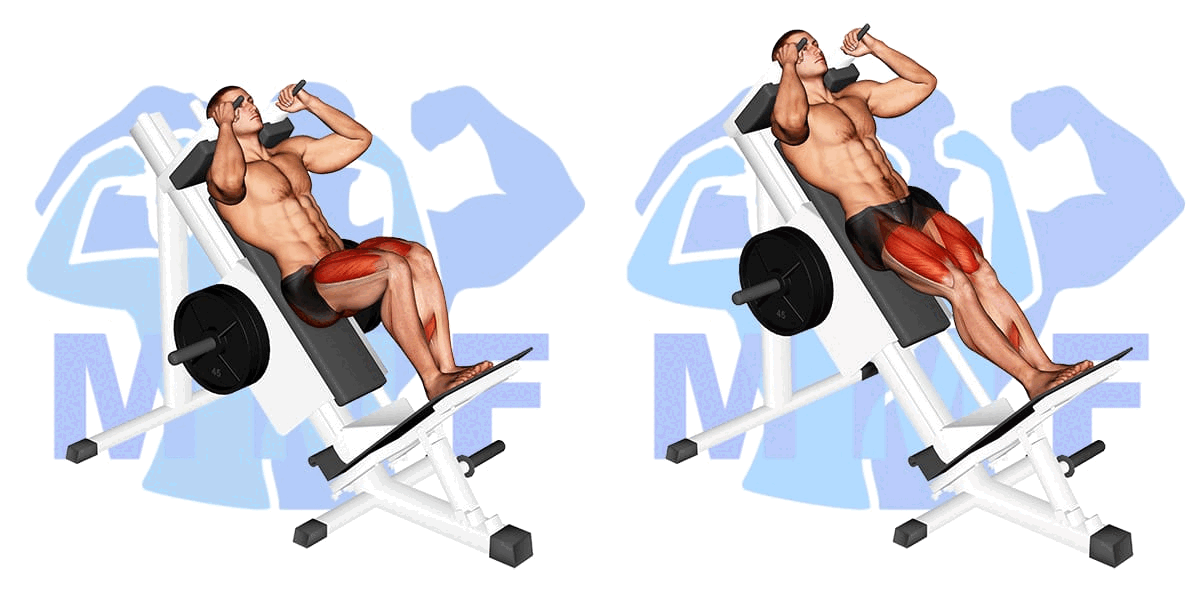

The Kneeling Cable Crunch use to be one of the most common abdominal (stomach) exercises used in the gym. The Kneeling Cable Crunch, when performed correctly, will build and strengthen abdominal (abs) muscles more quickly than other crunches.
- The Benefit of a Strong Core
- Rectus Abdominis Muscle Physiology Summary
- Cable Kneeling Crunch Summary
- Correct Exercise Procedure Use for Cable Kneeling Curls
- Kneeling Cable Crunch Muscles
- Tips for Performing Cable Kneeling Curls
- Frequent Mistakes Made While Performing Cable Kneeling Curls
- Variations of Exercise or Equipment Use for Cable Kneeling Curls
- Other Exercises to Compliment Cable Kneeling Curls
The abdominal muscles (stomach) muscles are essential “core” muscles. The core muscles consist of the abdominals, the obliques, the lower back muscles and several inner muscles of the trunk of your body (not including arms and legs). All of these muscles work together so that you can bend and twist and many other movements that you Table done every day.
The Benefit of a Strong Core
One significant benefit of improved core strength is an improvement in posture. Weak abdominals will cause you to have a forward lean. Likewise, any other weak muscles will cause the additional muscle to compensate for that which results in poor posture. So as you can imagine having a stronger core will reduce posture problems. Improving core strength will allow you to lift more weight in almost any other lift that you would want to do! With a strong core, it will help you stabilize the rest of your body. Stability is especially important when doing multi-joint lifts such as a squat or bench press. For athletes a strong core is crucial to improve performance, there is always a need to be able to stabilize your torso as well as move with it quickly. Strengthening the body’s core muscles are essential for preventing potential injuries. Weak core muscles can contribute to injuries to other parts of the body, especially the lower back.
Having a strong core is also important for aesthetic (physical appearance) reasons. While building a strong core, you can burn fat. Additionally building core muscles can help tighten up your physique and make you appear skinnier. Lastly but certainly not least, a strong core improves posture which helps broaden out a frame. A strong core makes people appear stronger because their shoulders will be pulled back farther causing their chest to appear bigger, rather than the “curved, humped, sloop shoulder” look which is associated with weakness.
Working the abs, along with an excellent low-fat diet, and proper expenditure of calories will also result in a very pleasing physique.
Rectus Abdominis Muscle Physiology Summary
The abdominal muscles consist mainly of two large muscle groups, Rectus Abdominis, and Obliques. The Rectus Abdominus originates on the pubic bone and attaches to the ribs (5th, 6th, and 7th) and the sternum. Rectus Abdominus is responsible for spinal or lumbar flexion.
The Rectus Abdominus is what is commonly referred to as “washboard abs” because a well-defined rectus abdominis is said to look like the old washboards that were used to scrub clothes. It is also commonly referred to as the “six pack.” While the “six pack” is by far the most common configuration abdominal muscles of the rectus, your could be one of the rare individuals that have an anatomic variations which result in the appearance of eight (four per side) muscle segments (“eight pack”), ten, or (even more occasional) asymmetrically arranged parts. All these variations are natural and functionally equivalent. A well-defined rectus abdominis often carry cultural connotations of superior physical fitness which is why so many people work the abs and strive to obtain the “six pack.”
Cable Kneeling Crunch Summary
- Primary Muscle(s) Worked: Rectus Abdominis (abdominals)
- Other Muscles (Secondary) Worked: Obliques
- Equipment: High pulley cable with the rope attachment.
- Mechanics Type: Isolation.
- Force: Pull.
- Utility: Auxiliary.

Correct Exercise Procedure Use for Cable Kneeling Curls
- Facing cable tower, kneel below the high pulley and grab cable rope attachment with hands.
- Place wrists against head, flex hips slightly and allow the weight to hyperextend the lower back.
- With hips stationary, flex waist, so elbows travel toward middle of thighs while exhaling.
- Pause and return to starting position, while inhaling, keeping tension on abdominals.
- Repeat.
Kneeling Cable Crunch Muscles
Target (Agonist)
- Rectus Abdominis
Synergists
- Obliques
Dynamic Stabilizers
- None
Stabilizers
- Iliopsoas
- Tensor Fasciae Latae
- Rectus Femoris
- Sartorius
- Latissimus Dorsi
- Teres Major
- Deltoid, Posterior
- Triceps, Long Head
- Rhomboids
- Trapezius, Lower
- Pectoralis Major
- Pectoralis Minor
- Serratus Anterior
Antagonist Stabilizers
- None

Tips for Performing Cable Kneeling Curls
By using these tips below, they will help your muscles fully develop by incorporating more muscle fibers per rep. You will be more efficient and productive during your workouts thereby increasing the muscle’s size and strength.
- Practice proper form and control. Starting with this exercise, or any lift you have not performed before, you should start by using light weights until you have the full range of movement with proper extension and contraction. Starting a light resistance and completing the full range of motion is vital for the muscles full development.
- Keep hips stationary. Your butt should stay touching your heels at all times and without pivoting at the hips.
- Concentrate on abdominals: Concentrate on crunching your abs in, the movement occurs in waist not hips.
- Use a weight that allows smooth and controlled motion. Cheating will take the emphasis off the abdominals.
- Alternative rope and hand position: As you increase weight, it may be more comfortable to rest the rope and hands on shoulders.
Frequent Mistakes Made While Performing Cable Kneeling Curls
When you perform the exercise improperly, often referred to as cheating, you will not allow for your muscles and muscle fibers to use their fullest potential. Cheating will almost always result in not achieving the desired development of your muscles.
- The movement performed too fast. If the motion is executed too quickly, it will not allow full usage of all muscle fibers.
- You are using hips to help. Do not pull weight by helping with the hips. Improper form (cheating) will not allow all of your abdominal muscle fibers to be used, defeating the purpose of this exercise.
- You are not pausing and bottom of the movement. Squeeze or crunching your abs at the bottom of the action is a must for fatiguing your abs quickly.
- You are lifting your butt. When raising your butt off the heels, you are using body weight to help the abs in the movement.
- You are limiting the range of motion. You may see many lifters not going all the way up or down and not squeeze at the bottom of the movement. If you don’t use the full range of motion, less of your muscle fiber will be worked, and less growth will occur.
Variations of Exercise or Equipment Use for Cable Kneeling Curls
A variety of a specific exercise is intended to work different subgroups of muscles or work the same muscles in slightly different ways. There are many exercise variations to this strength exercise. Here are some variations you can use for the cable kneeling curls:
- Cable Standing Crunch. These have the same benefits with same synergists, and stabilizers use, but using a standing position instead of kneeling.
- Cable Seated Crunch. Same as Cable Kneeling Curls but without any significant stabilizers are used.
- Cable Lying Stability Ball Crunch. Same benefits as cable kneeling curls but with fewer stabilizing muscles will be used. Interesting note, the stability ball with most exercises require more stabilizing muscle to use but in this case, fewer are utilized when compared to cable kneeling curls.
Other Exercises to Compliment Cable Kneeling Curls
- Weighted Hyperextension. Hyperextension exercise targets the Erector Spinae (lower back) for total core strengthening.
- Dumbbell Straight Leg Deadlift. Straight leg deadlift is one of the best exercises in targeting the Erector Spinae with using several stabilizers, including Antagonist Stabilizers Rectus Abdominis and Obliques.
- Abdominal Vacuum. Abdominal Vacuum is an isometric exercise targeting the Transverse Abdominis (the innermost of the flat muscles of the abdomen placed immediately beneath the internal oblique muscle) and compresses and supports abdominal viscera (stomach, intestine, liver, etc.).
- Cable Side bend. Cable side bends directly targeting and strengthening the obliques which you need for the total development of the body’s core and abdominal structure.
- Dumbbell Side bend. Dumbbell side bend is another exercise example for developing the obliques for strengthening the body’s core.
- Weighted Incline Twisting Sit-up. Incline twisting sit-up is more of an advanced exercise. Lying supine on incline bench you can either add more resistance by elevating the platform, adding weight, or both. Weighted incline twisting sit-ups are an excellent oblique exercise, or you can efficiently perform weighted incline sit-ups without the twist for an exceptional abdominal exercise workout.
Bottom Line
The Cable Kneeling Crunch is an excellent low-impact way to exercise the abdominal muscles and to strengthen your core. Cable crunches are a great way to get your midsection those six pack abs!!!